At Dorstone Hill, archaeologists excavating Neolithic burial monuments found shards of rock crystal laid at the foot of ancient graves. The crystal had been carried across great distances to rest beside the dead. Why this material? To connect the living with the dead through something precious? To mean something we can no longer read? Rock crystal turns up throughout history, and its meaning seems as multifaceted as the stone itself. That question runs through Alexander Lamont’s Fonte de Glace vessels, and I want to follow it through some of the places crystal has mattered most: death, desire and the divine
The name does a lot of the work. Krystallos is Greek for ice, and the Romans took that literally, explaining the stone as water frozen permanently and excessively [Crowley, p. 152]. A liquid made enduring: poets and philosophers loved the idea, and I think it shows how the story we tell about a material shapes our fascination with it. That fascination persists in today’s crystal-and-healing culture, which is only the latest chapter in a very long tradition of asking crystal to do something for us.
It is also an uncooperative material. Natural rock crystal is extremely hard, full of inclusions, lattices and stress lines, and carving it means working with the stone’s habits, not against them. It is both solid and seemingly melting, something you can touch and look through at once. Galvez, writing on crystal and desire in medieval texts, notes that its degrees of transparency and stages of formation made it a way of reaching for an unattainable object of desire [Galvez quote, p. 79]. Crystal was a portal to someone or something out of reach.
Centuries after the Romans, the Byzantine poet Manuel Philes wrote of crystal with reverence:
[Philes verse, trans. Crowley, p. 151]
In Philes, the stone itself is devout. Its transformation becomes a religious act, and the Lord becomes a crystalline body. From here, piety and desire begin to tangle.
Anne von Ramschwag, a fourteenth-century Swiss noblewoman, nun and mystic, was said to become “as clear as crystal” (ein cristalle), a glow of light emerging from within her [Galvez, p. 80]. Her flesh turns transparent, a body lit by grace. Crystal is dug out of the earth, yet here it signals transcendence, a body half corporeal and half godly. I find that contradiction as layered as the stone.
Crystal can also mean absence. In Dante’s Rime Petrose, water turning to crystalline stone in cold air becomes an image of his blood freezing under his lady’s coldness [Galvez, p. 82]. Turning to crystal becomes turning to stone, and purity becomes hardness. So perhaps crystal reveals unmet desire as well as being the portal through which desire shines. Suger, quoted by Galvez, placed crystal in some strange region of the universe, neither the slime of the earth nor wholly the purity of Heaven [p. 80]. That stayed with me. However otherworldly the material seems, it comes from the same earth we do, and our desire sits between earthly and heavenly in the same way. It also captures what crystal does in the hand: patterns you can see into but never reach, and a surprising weight.
A stone you can touch but struggle to see into carries presence and absence at once, which is why it has held scholars and mystics for so long. It promises contact with what has been lost, and can just as easily be a cold reminder of desire frozen over.
Perhaps that is why crystal was so often made into vessels. The shards at Dorstone were carried across the land and set beside the dead. Later, crystal was shaped into reliquaries and chalices, objects built to hold something precious and let you see it, or almost. A vessel gives desire somewhere to rest.
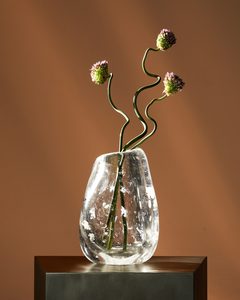
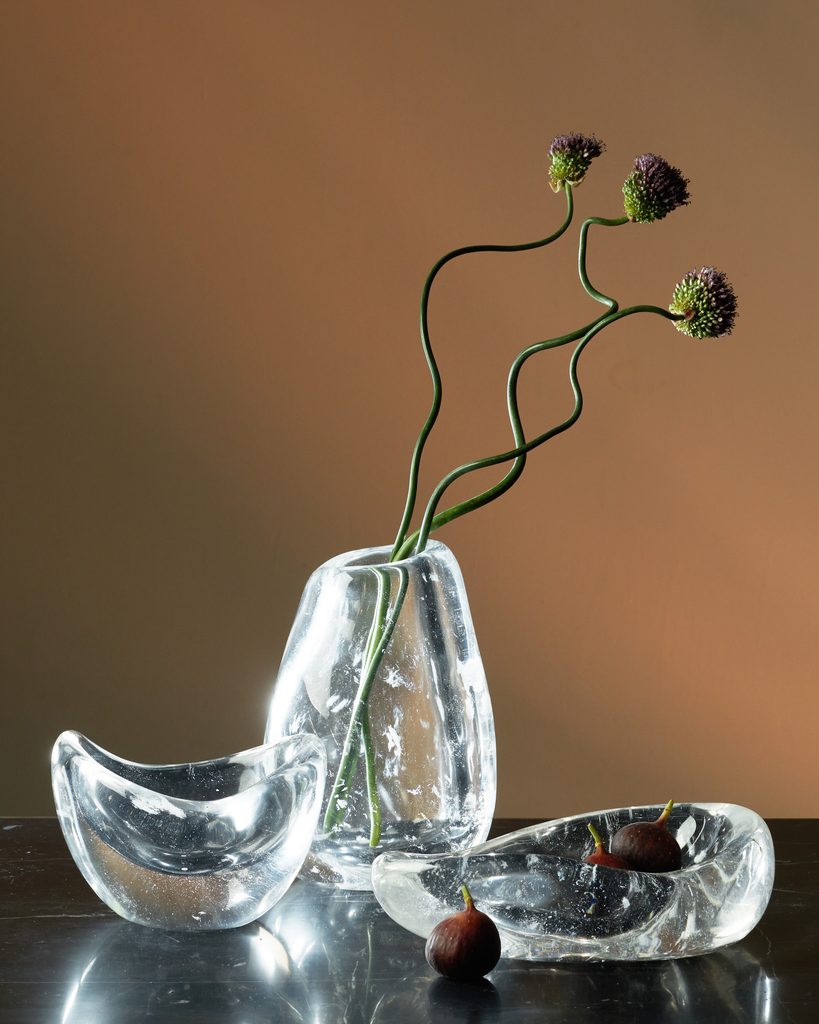
That is the idea behind the Fonte de Glace vessels. Lamont’s are made from man-made rock crystal that matches the mineral composition, hardness and clarity of the natural stone, without the mining that sourcing new crystal involves. It is a quiet turn on the old story: the Romans believed crystal was water made permanent, and these pieces are formed rather than dug out of the ground. Working with a team of experienced carvers, Lamont has made new crystal objects this year, including the Coupé Vessels, so large they would be impossible to source in natural rock crystal. Hold one up to the light and the old questions come back: what is held, what is seen, and what stays just out of reach.